
Temporary Storage Buildings vs Permanent Structures: Which Saves More Money?
When It Comes to Storage Infrastructure, the Cheapest Option Isn't Always the Most Cost-Effective
Storage requirements are changing faster than ever.
A manufacturing unit may need additional warehouse capacity for the next three years. A logistics company may require a distribution hub closer to a new market. An e-commerce business could be preparing for seasonal inventory spikes, while an infrastructure project might need covered storage only for the duration of construction.
In each of these scenarios, the question isn't simply "How do we build a warehouse?"
It's "What kind of storage infrastructure makes the most financial sense?"
For years, permanent warehouses were considered the default solution. Today, businesses have another viable option—engineered modular structures that can be deployed quickly, expanded as demand grows, and adapted to changing operational needs.
The challenge isn't choosing between temporary and permanent. The challenge is choosing the solution that delivers the best return on investment for your business.
Looking Beyond the Initial Construction Cost
Many investment decisions begin with comparing project budgets.
While construction cost is important, it represents only one part of the financial picture.
A smarter comparison considers factors such as:
- Time required before the facility becomes operational
- Capital tied up in construction
- Maintenance requirements
- Future expansion possibilities
- Operational flexibility
- Long-term business plans
A building that costs less today may become expensive if it cannot adapt to future business needs. Similarly, investing heavily in permanent infrastructure for a short-term requirement may not always deliver the best financial outcome.
Understanding these trade-offs is the first step toward making an informed investment.
When Speed Creates More Value Than Permanence
In industries such as manufacturing, logistics, mining, infrastructure, and agriculture, storage demand often arises unexpectedly.
Waiting several months for conventional construction may not be practical when production is increasing or inventory needs immediate protection.
This is where temporary storage buildings have become an attractive solution.
Modern modular storage structures are engineered for rapid deployment while providing the durability required for industrial applications. Businesses can begin using the facility much sooner, reducing operational disruptions and responding quickly to market opportunities.
Rather than viewing these structures as short-term alternatives, many organizations now consider them strategic assets that support business continuity during expansion, seasonal demand, or project-based operations.
Permanent Structures Continue to Deliver Long-Term Value
That doesn't mean permanent buildings have become obsolete.
For organizations with stable, long-term operations, permanent steel buildings remain one of the most reliable infrastructure investments.
Manufacturing plants, distribution centers, industrial warehouses, and production facilities often require buildings designed for decades of continuous use.
These projects typically benefit from customized structural layouts, heavy equipment integration, mezzanine floors, overhead cranes, and future production planning.
Because every business operates differently, the decision should never be based solely on whether a structure is temporary or permanent—but on how well it supports operational objectives over its lifecycle.
This is one of the reasons companies increasingly prefer working with engineering partners like ClearSpan Structures India Pvt. Ltd. Instead of recommending a single construction system, the team evaluates project duration, operational requirements, expansion plans, and investment objectives before suggesting the most suitable solution. Whether that means a modular aluminium structure or a permanent steel building, the recommendation is driven by the application—not by the product.
Flexibility Has Become a Business Advantage
Business requirements rarely remain static.
A warehouse built for today's operations may need to accommodate higher inventory volumes, additional loading bays, or new production lines in the future.
This is where modular infrastructure offers a significant advantage.
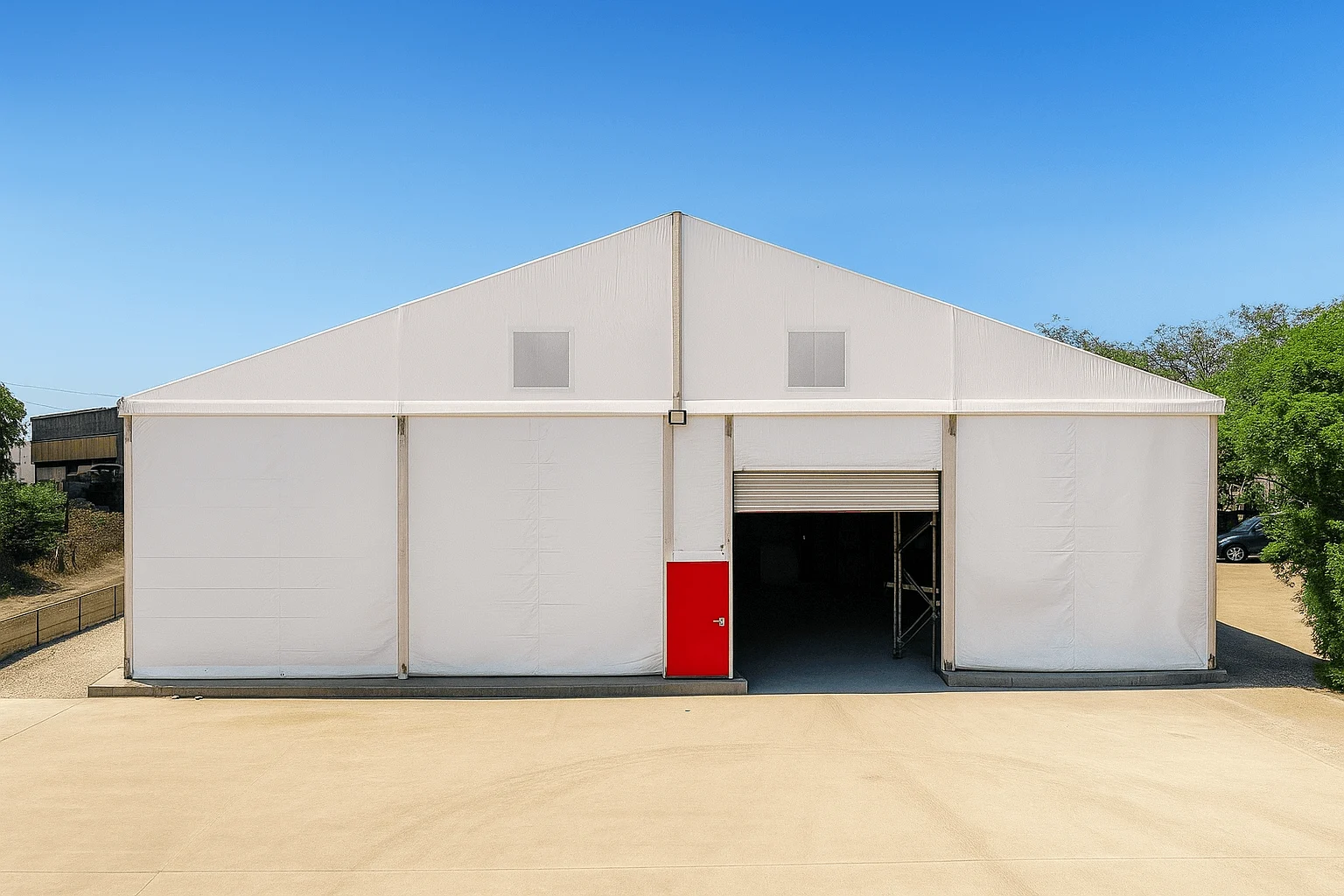
An engineered warehouse storage tent can be expanded in phases, allowing businesses to increase capacity without disrupting ongoing operations. This phased approach also helps organizations invest only when additional space is actually required.
Permanent buildings can also be designed for future expansion, but this requires careful planning during the initial engineering stage to avoid expensive structural modifications later.
The key isn't choosing the "more flexible" option—it's selecting infrastructure that aligns with the company's growth strategy.
The Hidden Costs Businesses Often Overlook
When comparing storage solutions, businesses tend to focus on visible costs such as construction and installation.
However, several hidden factors often have a greater impact on the overall investment.
Questions worth asking include:
- How quickly can the facility become operational?
- Will future expansion require major structural changes?
- Can the building adapt if business priorities change?
- How much working capital will remain available after construction?
- What are the ongoing maintenance requirements?
Answering these questions often changes the conversation from "Which building is cheaper?" to "Which investment creates greater business value?"
This is precisely why infrastructure planning has become a strategic decision rather than simply a construction exercise.
Choosing the Right Storage Solution Starts with Understanding Your Business
Every project has different priorities.
A logistics company launching operations in a new region may prioritize deployment speed.
A manufacturing facility expanding production may focus on long-term operational efficiency.
A project site requiring storage for three years has completely different requirements than a warehouse expected to operate for the next thirty years.
For some businesses, a warehouse tent provides the agility needed to respond quickly to changing market conditions. For others, a permanent steel structure represents the strongest long-term investment.
Having expertise in both solutions allows ClearSpan Structures India Pvt. Ltd. to guide businesses toward the most suitable option instead of forcing a one-size-fits-all recommendation. With capabilities spanning Pre-Engineered Buildings (PEBs), tubular steel structures, aluminium frame systems, and modular storage solutions, the company helps clients build infrastructure that supports both current operations and future growth.
Conclusion
There is no universal answer to whether temporary storage buildings or permanent structures save more money.
The answer depends entirely on how your business operates.
If speed, flexibility, and phased investment are the priority, modular storage solutions can offer significant financial and operational advantages.
If long-term industrial operations, specialized equipment, and decades of continuous use are the goal, a permanent steel structure may deliver stronger lifecycle value.
The most successful infrastructure investments begin with understanding the business—not selecting the building first.
That philosophy is what drives every project at ClearSpan Structures India Pvt. Ltd. By offering both modular aluminium structures and permanent steel buildings, ClearSpan enables businesses to choose the right solution for the right application, ensuring every investment is aligned with operational efficiency, scalability, and long-term value rather than a one-size-fits-all approach.